
Work Word World
or Story #7
A piece of ‘creative non-fiction’ in which I confess that I don’t like writing, and yet I keep writing. Plus, some tips for writing on, about and from dance
Dance and words. They’re an odd couple for sure, maybe even incompatible. One is bodied, the other voiced. One shows, the other tells. One gestures, the other specifies. One is multidirectional, the other sequential. One is marginal, the other mainstream. The list could go on, so let’s just spell it out: one is non-verbal, and the other is quite literally verbal. Seriously, why force them together?
Yet that is what I have been doing for more than two decades now, as a dance writer and critic. What made me do it?
Story #1. It was a chain reaction. Someone asked me to write something on dance and I said yes, after which someone else asked me to write something and I said yes, then the loop started repeating and the rest is history.
Story #2. Dance and words are both fundamentally human. All over the world, people dance, people speak. Compatible or not, like it or not, that is how we are and who we are. Dance and words have already set up house within us. Far from forcing them together, we are just living with the consequences.
Story #3. Odd is interesting. If life were all even it would be flat, and where’s the fun in that? The niggle, the snag, the catch, the mismatch – these are what capture our curiosity and pique our imaginations.
Story #4. Ask a therapist. With parents of different races and cultures, and with a non-identical twin brother, could it be that I am unconsciously, existentially and maybe neurotically compelled by the figure of the odd couple? I can’t answer that. So put me on a couch and psychoanalyse me. Maybe you can.
Breakup
Make of those stories what you will, the fact is that dance and words have tangoed through a lot of my life: our tales are intertwined. But let’s skip the details and fast forward to 2020. It was the year we all sort of decoupled. Covid-19 spread across the world, putting the brakes on most social life. Theatres closed. Audiences could not gather, even outdoors. Beyond the occasional screencast, dance came to an effective standstill, and so did my writing about it. Dance, words, me – our stories separated in 2020. I still remember that time clearly: how lovely it was, how liberating.
Let me admit something that all my friends know and none of my colleagues suspect: I don’t like writing. It’s painful, it’s laborious, and I don’t enjoy it. When I don’t have to write anything, I write nothing, and I am happy that way. Yes, there’s more to the story than that: though I don’t like entering the dark tunnel of writing, my spirits do lift when I see light at the other end, and I can start working towards an exit. When I emerge, I often enjoy the feeling of having written: I get a sense of achievement, of having learned something about both dance and words, and I am delighted that I don’t have to write any more.
Pandemic restrictions forced a retreat from work and words, and I could stop burrowing into that tunnel. Like the London air outside, freer of human exhaust and combustion than I had ever known it, the space within me also felt open-skyed and unpopulated. Walking or cycling through the hushed streets of the city, I would feel a soft, and I think restorative connection with movement, not dance. The few people outdoors kept away from each other, and it was soothing and sublime to sense the motion of a world from which we were largely absent. The curving glide of pigeons, the pulsed wingbeats of finches. The shiver of leaves. The downward slant of rain and the slow, sideward slide of clouds. The peeled corner of a theatre poster flapping in the wind, like one hand idly clapping for no one, and for nothing. All the world was moving and alive, and it had no need of our presence to interpret, communicate or understand it. Those compulsions come from us, not it.
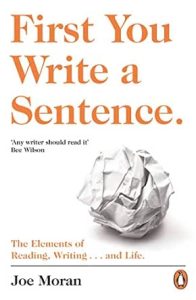
Inside, a more reflective space opened up too. Instead of writing words, I found myself reading them. Not words about dance, but about words themselves – about language. One book in particular became a close and tender companion: First You Write a Sentence by Joe Moran, subtitled The Elements of Reading, Writing… and Life. It is dedicated to that elemental unit of written meaning, the sentence, and it gives care and attention to noticing how sentences can work, separately and together, and what effects they can induce. In the process, the book becomes what Moran finally understands as “a love letter to the sentence – this thing that can make me feel as if I am talking into a void, but that has always, in the end, reunited me with world.”
It seemed that I had separated dance and writing from each other – and retreated from both – in order to connect with each on a more primal level: as movement, and as language. Yet even as I read Moran’s words-about-words, I found them brimming with movement and with qualities of movement: flow, rhythm, action, progression, momentum. One whole chapter argued for more verbs (active, moving, in process) and fewer nouns (static, conceptual, thing-like), and I thought it directly applicable to writing about dance. I decided that dance writers, particularly the more academic ones, could learn a lot from Moran’s book, and I wondered if choreographers (particularly the more academic ones) might do the same. Was I starting to recouple dance with words?
Where is joy?
That was spring 2020. In the autumn, out of the blue, I received a message from Ann Van den Broek’s company WArd/waRD, based between Antwerp and Rotterdam. They were working on a new piece on the theme of joy (it ended up as two linked pieces, Creating Joy and Joy Enjoy Joy) and asked me if I could write something for them around the production. It was Story #1 all over again – nearly. Instead of saying yes, I said yes, if. Yes, if it’s not a review or a preview or an interview or a profile. Yes, if it’s not an analysis or a commentary or a choreochronicle. Yes, if I can try something different. And they said yes – if I sent them a sample and they liked it. So we had a deal. Let’s call it Story #5: Yes, if.

The proposal I made was this: instead of writing about dance, why not write from it? I would take some moment or feature of the work as my point of departure, then follow a line of thought out into the wider world, without knowing what route it would take or where it would lead. Between the work and the world, the words themselves would become the tracks left on the page.
I think I have the pandemic to thank for this impulse too. We were largely confined indoors and restricted to our neighbourhoods, and the dance writing I had been doing felt similarly prescribed. The idea of writing more exploratively felt like a kind of travel, a way of getting out of the house and going somewhere unknown and far away.
In any case, I sent a sample to WArd/ waRd and they said yes; so I said yes.
Story #6. It was destiny! The word joy is literally in the middle of my name. In the end, all I could do was accept my fate.
Travelogue
That story is pure fantasy; ignore it. Back in the non-fiction world, Work/World – as we ended up calling this little book of eight “excursions” – was not a joy to write (my fate, it seems), though I did find it fascinating, and rewarding. But who cares what I felt? Once a text is published, the writer’s experience, feelings and intentions are at best irrelevant, at worst intrusive. All that matters is the text, the reader, and what happens between them. So let me tell you about the text.
It has a range of different starting points, because the performances offer them. Both Creating Joy (2021) and Joy Enjoy Joy (2022) are not choreographed movement supported by sound and set, but rather agglomerations of different means and meanings, none of which stays in prime position. Movement – encompassing composed dance, functional movement and expressive gesture – is one just element, alongside sound (some scenes feel like gigs), lots of camerawork, both live and recorded, and plenty of other media such as words (live and recorded again), changeable costumes and moveable scenery. The works may be labelled dance, but they form fertile ground for unearthing all manner of curiosities, oddities and conversation pieces.
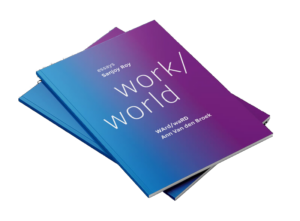
The eight chapters of Work/World reflect that profusion. One begins with a compositional idea (loops), another with a corporeal one (the hip). There are chapters starting from words, one from footwear, and one from wondering about the difference between a step and a gesture. What routes do they follow? One leads into the field of self-help psychology, another swerves through classical sculpture and competitive ballroom dance. One delves into a niche fandom tucked inside the world of rock guitar, and there are many diversions through film – Pixar animations, Invasion of the Body Snatchers, Battlestar Galactica, Charlie Kaufman, Agnès Varda. In this way, the words form filaments of a web that embeds the dance works within much wider worlds.
Where do these little culture trips end, and what is their goal? Well, as in life itself, the pleasures, pains, excitements, discoveries and disillusions of travel come from the journey, not the destination. Reading the words now left printed on the page, it seems to me that several features recur along the way – none more than the figure of death, who on occasion steps directly into the path, but is often more unobtrusively present in the form of a shadow, watcher, or travelling companion. For a work exploring joy, I think that is inevitable.
Back home
That is my reading. Your reading will emerge between the words and you. Our interface, then, is the words. Let me return to them now, and to our odd couple. I’ve often been asked: how do you write about dance? It’s impossible! And I reply: you’re telling me. In Work/World I started in dance and let the words walk away – which was easier. The words took their own path, leaving the dance to its own devices. No one tried to keep them tied together, yet they inhabited the same world and amicably crossed paths within it. Can they be so convivial when they have to live in each other’s spaces? Can any couple? It is delusional, even narcissistic, to imagine that there could or should be some perfect union; what matters are the more flawed, ephemeral capacities to cohabit, to care, to learn, and to let incompatibilities be.
The question remains though: how do I write about dance? I don’t have an instruction book, but I do have some suggestions, and two principles.
Principle #1. It won’t work unless the words work.
Principle #2. You can’t force the words to work.
Words are all that the reader has. If they don’t work, nothing works. How do you make them work? Well, you can’t “make them work”. All you can do is to align yourself to language, and become dextrous with the possibilities of this imperfect symbiosis. No one learns to pirouette through sheer force of will. They learn by repeatedly attuning themselves to the action such that it becomes possible. It is the same with playing an instrument – and with writing. You can’t just impose yourself upon the keyboard, whether of the piano or the computer, but you can, with practice, become more attuned to your medium.
Here are a few suggestions for that practice.
Practice #1. There are three dimensions to a written text: subject, structure and style. Many people focus almost exclusively on the first, obsessing over trying to make the words say what they want them to say. Try paying more attention to the others. This relieves pressure from the “problem” – what you want to say – and gives the words more freedom to speak for you.
Practice #2. Words cannot capture motion, but they can evoke it, by two main means: verbs and images. Dance is about people moving, for which there is a concise linguistic counterpart: subject–verb. Build your repertoire of juicy verbs, and use them actively; it will give life and motion to your words. Imagery, meanwhile, likens what can’t be put into words with something that can. Very handy for dance writers.
Practice #3. If dance is an art, it makes sense to use the artful devices of language when writing about it. Practise reading with an eye on the crafts and techniques of the written word – then use them to your own ends.
Practice #4. Write less, not more. It will allow more breathing space for the reader’s imagination. Plus: the volume of words that we pump into the world already exceeds all human capacity or use, and efficiency is better than overproduction.
Practice #5. Take pleasure in writing where you can – but if you can’t, it doesn’t matter. What does matter is that your words give pleasure to the reader, at least some of the time. “I’ve suffered for my art,” quipped the musician and comedian Neil Innes. “Now it’s your turn.” Laugh – and learn.
True story
Covid-19 is still with us as I write, but we’re well past the confinements of 2020 now. Work/World was conceived in those circumstances, is now published, and since then I seem to have returned to the normalities – reviews, profiles, programme notes – of writing about dance.
But not completely, I hope. Take this text, for example, which is based on a true story about the separation of an incompatible couple during times of pestilence. I’ve titled it ‘Work Word World’ because that sounds good, but it’s essentially a long answer to its own opening question, so we could just call it: Story #7.
With thanks to:
Joe Moran – or, more exactly, to the words he published as First You Write a Sentence: the Elements of Reading, Writing… and Life (Penguin, 2018)
Karthika Naïr, for introducing me to the concept of ekphrasis (writing from art rather than about it)
Trusted readers Stephen Guy, Marisa Hayes, Karthika Naïr, Anita Roy
Ann Van den Broek and WArd/waRD company for giving me the space to work on Work/World
First published in Taneční aktuality/Dance Context – Special Edition 2023, on Dance and Words. To order this or any other annual Special Edition in printed or PDF format, visit www.tanecniaktuality.cz/en/projects/special-edition/order-special-edition-here
PROMO CODE: get 50% discount on the PDF of any Special Edition with promo code Roy
For more about Work/World, see sanjoyroy.net/2022/10/work-world
To order Work/World (price €6), visit wardward.be/en/workworld-eng